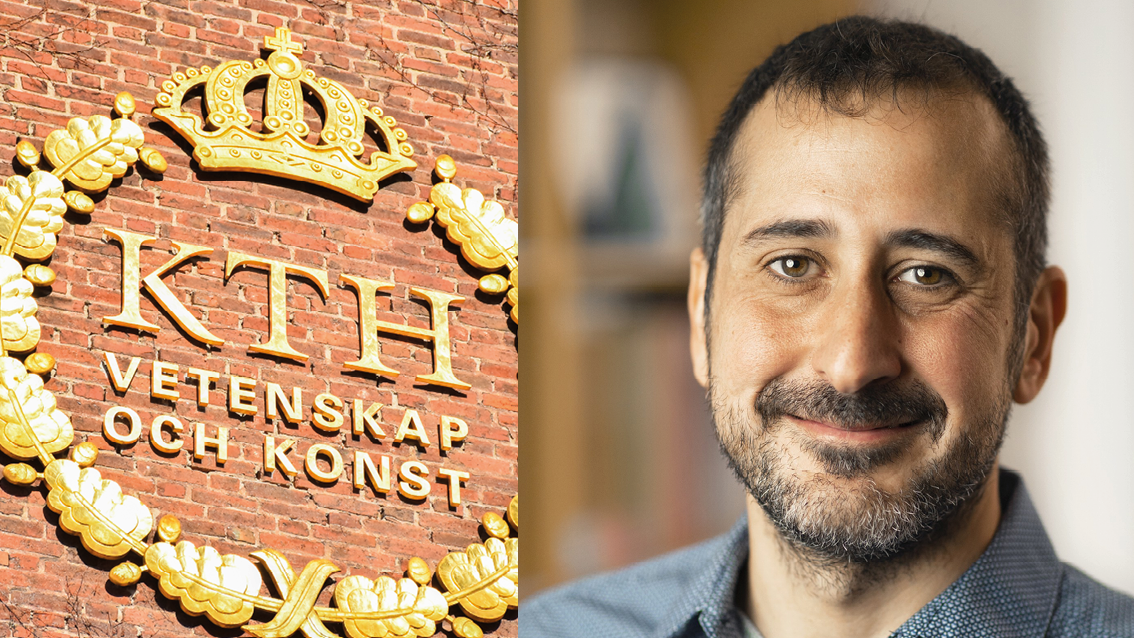
Patents, new technological solutions, and the knowledge of tomorrow. Research and innovation projects that bring academia and industry together create value long after the projects themselves have ended. Oscar Quevedo-Teruel, Professor at KTH Royal Institute of Technology, has spent many years witnessing how collaboration helps build a more forward-looking Sweden.
When Oscar Quevedo-Teruel reflects on the research and innovation projects he has participated in during his years as a professor at KTH Royal Institute of Technology, one thing stands out time and time again: the value of collaboration.
As a professor in Electrical Engineering and Computer Science, he conducts research in electromagnetics, antenna technology, and metasurfaces – technologies used in everything from communications and radar systems to sensors and space applications. But for him, research is about more than scientific breakthroughs. It is also about creating value beyond the walls of the university.
”Universities play an important role in strengthening industry and contributing to societal development. Through research, education, and innovation, we can help companies become more competitive while also building the knowledge needed for the future,” says Oscar Quevedo-Teruel.
His interest in collaboration between academia and industry began during his master’s thesis project at Chalmers University of Technology. There, he worked on a project involving mode stirrers, with the Swedish company Bluetest as one of the partners.
”Early on, I saw how research can be used to solve real-world industrial challenges. It inspired me to continue working in applied research and showed me how important it is to build strong links between academia and industry.”
Since then, collaboration has become a natural part of his work. According to Oscar, much of the strength lies in the different perspectives that academia and industry bring to the table. Universities can focus on long-term research questions and explore new ideas, while companies contribute concrete needs, challenges, and experience from real-world applications. This also helps Sweden remain agile and competitive. In fields such as electromagnetics, research often involves developing new simulation methods or theoretical models—work that requires both specialist expertise and a long-term perspective.
”When academia and industry work together, ideas can be translated into practical solutions more quickly. At the same time, we gain the opportunity to tackle complex problems that otherwise might never be addressed.”
Over the years, these collaborations have resulted in new antenna and microwave concepts as well as more efficient simulation methods that industry now uses in product development. Several projects have also led to patents for industrial partners, while the results have been disseminated through scientific publications and international conferences. However, the long-term impact extends beyond technology alone.
”Talent development is just as important. Many of our students and postdoctoral researchers have gone on to work for companies in the Swedish and European electronics and telecommunications industries. In this way, the projects strengthen both the companies and their products.”
Many of the collaborations that began within research projects continue to this day and have evolved into broader national and international partnerships. The projects have also helped open up new research directions in areas such as communications technology, radar, sensors, and space systems. For KTH, this means that research continues to generate new knowledge and contribute innovation to Swedish and European industry while educating the next generation of experts in electronics and telecommunications.
Looking ahead, Oscar sees continued collaboration as a decisive factor for Sweden’s competitiveness. He highlights the need for long-term investments in research and education through universities, as well as the importance of strong connections between universities, companies, and public-sector actors.
”If we are to maintain and strengthen Sweden’s position in electronics, we must continue investing in research, skills development, and collaboration between academia and industry. Areas such as advanced communication systems, semiconductor technology, and sustainable electronics will be particularly important in the years ahead.”
For Oscar, the connection is clear. When research, education, and industrial development come together, they create more than just new technological solutions. They also lay the foundation for the expertise, innovative capacity, and competitiveness that will be essential for the future of Sweden and Europe.